
How to Measure Marketing Success
Introduction
Creating a marketing campaign can be exciting. You choose an idea, design the content, publish it, and wait for people to notice it.
But there is one important question every marketer eventually needs to ask:
“Did it actually work?”
Getting likes, followers, or views can feel good, but these numbers alone cannot tell the complete story. Marketing success depends on what you are trying to achieve and whether your efforts are helping you move closer to that goal.
For beginners in digital marketing, learning how to measure marketing performance is just as important as learning how to create a campaign.
What Does Marketing Success Actually Mean?
Marketing success does not have one universal definition.
For one business, success might mean getting more website visitors. For another, it could mean generating leads, increasing sales, gaining brand awareness, or building a loyal audience.
That is why the first step is to clearly define the purpose of your marketing activity.
For example:
-
A new brand may focus on brand awareness.
-
An online store may focus on sales and conversions.
-
A service business may focus on lead generation.
-
A content creator may focus on engagement and audience growth.
The right measurement depends on the goal.
1. Start With a Clear Marketing Goal
Before checking analytics, decide what you want to achieve.
A useful goal should be specific enough to measure.
Instead of saying:
“I want my Instagram page to grow.”
you could define a goal such as:
“I want to increase meaningful engagement on my Instagram content over the next month.”
This gives you something measurable to track.
A clear goal also prevents you from becoming distracted by numbers that do not really matter to your business.
2. Track the Right Metrics
A metric is a measurement used to understand performance.
There are many marketing metrics, but you do not need to track every number available.
Reach and Impressions
Reach tells you approximately how many unique people saw your content.
Impressions represent the number of times content was displayed.
These metrics can help you understand how widely your content is being seen.
Engagement
Engagement can include:
- Likes
- Comments
- Shares
- Saves
- Clicks
Engagement can provide clues about how people are responding to your content.
However, high engagement does not always mean high sales. A post can receive thousands of likes without generating a single customer.
That is why metrics should always be connected to the original marketing goal.
3. Look Beyond Likes
Likes are easy to notice, but they are not always the most useful measurement.
Imagine two posts:
Post A: 1,000 likes but almost no website visits.
Post B: 300 likes and 80 people click the website link.
If your goal is to drive website traffic, Post B may actually be more successful.
This is why marketers need to look beyond surface-level numbers and understand what people do after interacting with content.
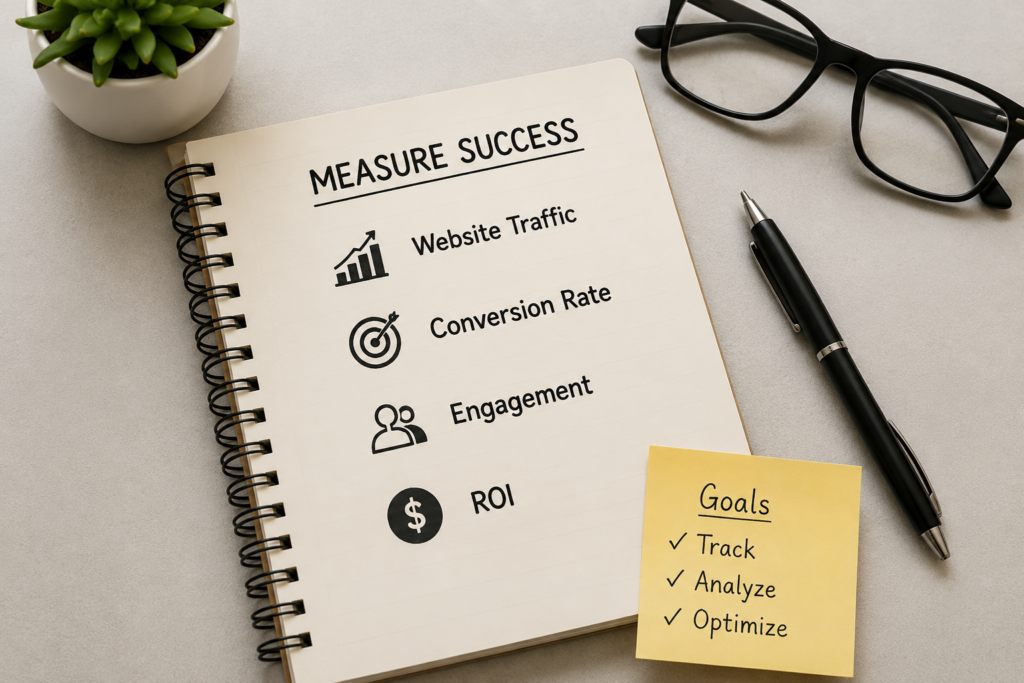
4. Measure Website Performance
If your marketing campaign sends people to a website, website analytics can reveal what happens next.
Useful measurements can include:
- Website visitors
- Traffic sources
- Page views
- Time spent on pages
- Landing-page performance
- Conversion rate
For example, social media may bring many visitors to your website, but if most visitors leave immediately, you may need to improve the landing page or make the content more relevant to the audience.
Marketing performance is not only about bringing people in. It is also about what happens after they arrive.
5. Understand Conversion Rate
A conversion happens when a visitor completes a desired action.
Depending on the campaign, that action could be:
- Making a purchase
- Filling out a form
- Signing up for a newsletter
- Downloading a resource
- Booking a consultation
- Registering for an event
The conversion rate helps marketers understand how effectively visitors are completing that desired action.
For example, if 100 people visit a landing page and 5 complete the desired action, the conversion rate is 5%.
This can help you evaluate whether your campaign is attracting the right audience and whether your website or landing page is convincing enough.
6. Calculate Return on Investment
Marketing requires time, money, and effort.
One important question is whether the results justify those resources.
Return on Investment (ROI) helps businesses evaluate the financial return generated from an investment.
A simple way to express ROI is:
ROI = (Return − Investment) ÷ Investment × 100
For example, if a campaign costs ₹10,000 and generates ₹15,000 in profit attributable to the campaign, the basic ROI calculation would be:
(₹15,000 − ₹10,000) ÷ ₹10,000 × 100 = 50%
The exact calculation can vary depending on what a business includes as revenue, profit, and marketing cost, but the principle is simple: understand what you spent and what you gained.
7. Compare Results Instead of Looking at One Campaign
One campaign’s numbers do not always tell the full story.
Comparing results over time can reveal patterns.
You might discover that:
- Videos receive more reach.
- Carousels generate more saves.
- Email campaigns produce more website clicks.
- Certain topics generate more leads.
- Some advertising campaigns produce better returns than others.
This information can help you decide where to focus your future efforts.
Marketing analytics becomes much more useful when it helps you make better decisions.
8. Use the Right Tools
Digital marketers have access to many tools for measuring performance.
Some commonly used platforms include:
- Google Analytics for website and user behaviour data
- Google Search Console for understanding performance in Google Search
- Meta Business Suite for Facebook and Instagram insights
- Email marketing platforms for opens, clicks, and campaign activity
- Advertising platforms for campaign and conversion data
You do not need to master every tool immediately.
Start with the platforms connected to the marketing channels you are actually using.
A Simple Marketing Measurement Framework
If you are a beginner, you can keep your process simple:
Goal → Metric → Result → Insight → Action
Goal
What do you want to achieve?
Metric
Which number can help you measure it?
Result
What actually happened?
Insight
What does the result tell you?
Action
What will you change or improve next time?
For example:
Goal: Increase website traffic
Metric: Website visits from social media
Result: Traffic increased
Insight: Educational posts generated more clicks
Action: Create more educational content
This turns analytics into a practical decision-making process.
Common Mistakes When Measuring Marketing Success
Focusing only on vanity metrics
Followers and likes can be useful, but they do not always represent business results.
Tracking too many numbers
Looking at dozens of metrics can make it difficult to identify what actually matters.
Changing strategies too quickly
Some marketing activities need time before meaningful patterns become visible.
Ignoring the original goal
A campaign should be evaluated against what it was designed to accomplish.
Not learning from unsuccessful campaigns
A campaign that performs poorly can still provide valuable information about your audience, message, timing, or strategy.
Final Thoughts
Marketing success is not simply about getting bigger numbers.
It is about understanding whether your marketing efforts are producing the outcome you wanted.
The best marketers do not just collect data. They use data to make decisions.
Start with a clear goal, choose meaningful metrics, study the results, and use what you learn to improve your next campaign.
Because at the end of the day, the most valuable marketing report is not the one with the biggest numbers.
It is the one that helps you understand what to do next.